
This article will be published soon
Scheduled for: 2026-05-20 17:46
The article will appear automatically when the time arrives — no need to refresh.
A Race Between Two Giants on the Terminal Interface
At the beginning of 2025, there was one clear leader in the AI coding assistant space: Anthropic’s Claude Code. But in May 2026, the landscape changed completely. OpenAI Codex is no longer just a “good competitor”. It has become a force to be reckoned with, and by certain metrics such as speed and cost, it has become the better choice for many developers.
The question now is whether OpenAI has truly pulled ahead of Anthropic. The answer depends entirely on what you measure. If you measure depth and problem-solving ability, Claude remains king. But if you measure speed, efficiency, and large-scale deployment, the gap is closing rapidly, and Codex may have already taken the lead in everyday developer adoption.
🔗 Official Website: anthropic.com/claude-code & openai.com/codex
The Bottom Line: Two Different Use Cases
To properly understand this competition, you must abandon the idea of a single winner. Both tools are excellent, but each has a completely different internal philosophy.
Claude Code is the architect. It is slow, deep, and consumes many tokens, but the output is production-ready most of the time. Choosing Claude means choosing quality over quantity, and it is suitable for critical projects. Codex is the fast robot. It is lightweight, fast, and consumes few tokens, and can run 5 tasks in parallel without waiting for you. Choosing Codex means choosing speed and efficiency.
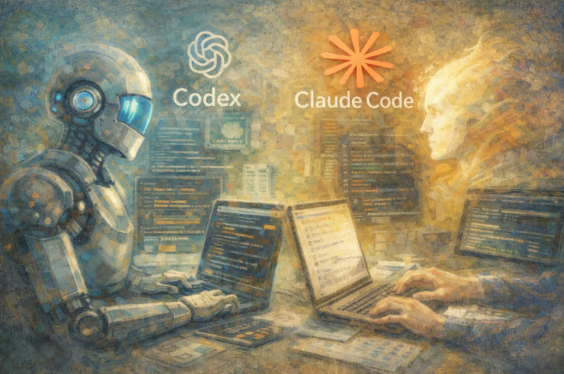
The visual comparison below shows the difference in philosophy between each tool:

1. Performance and Benchmarks: Depth vs Speed
This is where the fundamental difference appears. Claude excels at deep contextual understanding, while Codex excels at raw speed and handling simple tasks.
SWE-bench Benchmark (Real Problem Solving Ability)
This is the gold standard benchmark that measures an agent’s ability to solve real issues from GitHub repositories. Claude excels here clearly, thanks to its powerful Opus 4.6 foundation model.
- Claude Code (Opus 4.6): Achieves approximately 80.9 percent. This number is close to human developer performance, demonstrating that Claude truly understands what it is doing.
- OpenAI Codex (GPT-5.3): Achieves approximately 75.2 percent on the same verified benchmark version. This is still a very good score, but the 5 percent gap remains noticeable on complex tasks. However, on the newer Pro version, Codex sometimes surpasses Claude, scoring 56.8 percent versus 55.4 percent, indicating a rapid convergence in capability.
Terminal-Bench (Speed and Automation)
Here is where Codex takes its revenge. This benchmark measures agent performance on terminal development tasks, and in this domain, Codex’s speed is unmatched.
- OpenAI Codex (GPT-5.3): Dominates with a score of 77.3 percent. This speed comes from its lightweight Rust-based architecture.
- Claude Code (Opus 4.6): Achieves 65.4 percent here. Performance is slower because it consumes more time and energy on reasoning rather than rapid execution.
2. Code Quality and Engineering: Clarity vs Organized Chaos
If you are working on a large project, you might prefer Claude. In blind tests, developers prefer Claude’s code in 67 percent of cases because it is cleaner and more maintainable. The remaining 33 percent for Codex is usually faster to write but requires more human review.
This image illustrates the difference in code quality:

3. Token Efficiency: The Real Cost Difference
Claude consumes approximately 3 to 4 times more tokens compared to Codex. If you are paying via API, Codex is the undisputed economical choice. If you are using a monthly subscription of $20, both give you a certain limit of operations, but Codex will perform more tasks for the same price.
4. Technical Architecture and Open Source: Black Box vs Open Tools
Claude Code is a proprietary, closed-source application. You cannot modify it or know exactly how it works internally. However, it runs locally on your machine, ensuring greater privacy and confidentiality for your source code.
Codex is open source under the Apache 2.0 license, written in Rust, and preferred in CI/CD and automation environments because it runs in an “isolated cloud,” allowing multiple tasks to run in parallel easily.
Purchasing Decision: Which One Should You Choose?
Choose Claude Code if:
- You are refactoring complex systems.
- Code quality and cleanliness are more important than speed.
- You have the budget for $20 to $200 per month.
- You prefer the AI to work under your direct supervision.
Choose OpenAI Codex if:
- You work in workflow automation, DevOps, or CI/CD.
- Your budget is limited and you want maximum value.
- You need to execute multiple independent tasks in parallel.
- You want an open-source tool.

Reactions & Comments
Sign in with GitHub to leave a comment or react. Powered by Giscus (stored in GitHub Discussions)