
This article will be published soon
Scheduled for: 2026-10-27 12:36
The article will appear automatically when the time arrives — no need to refresh.
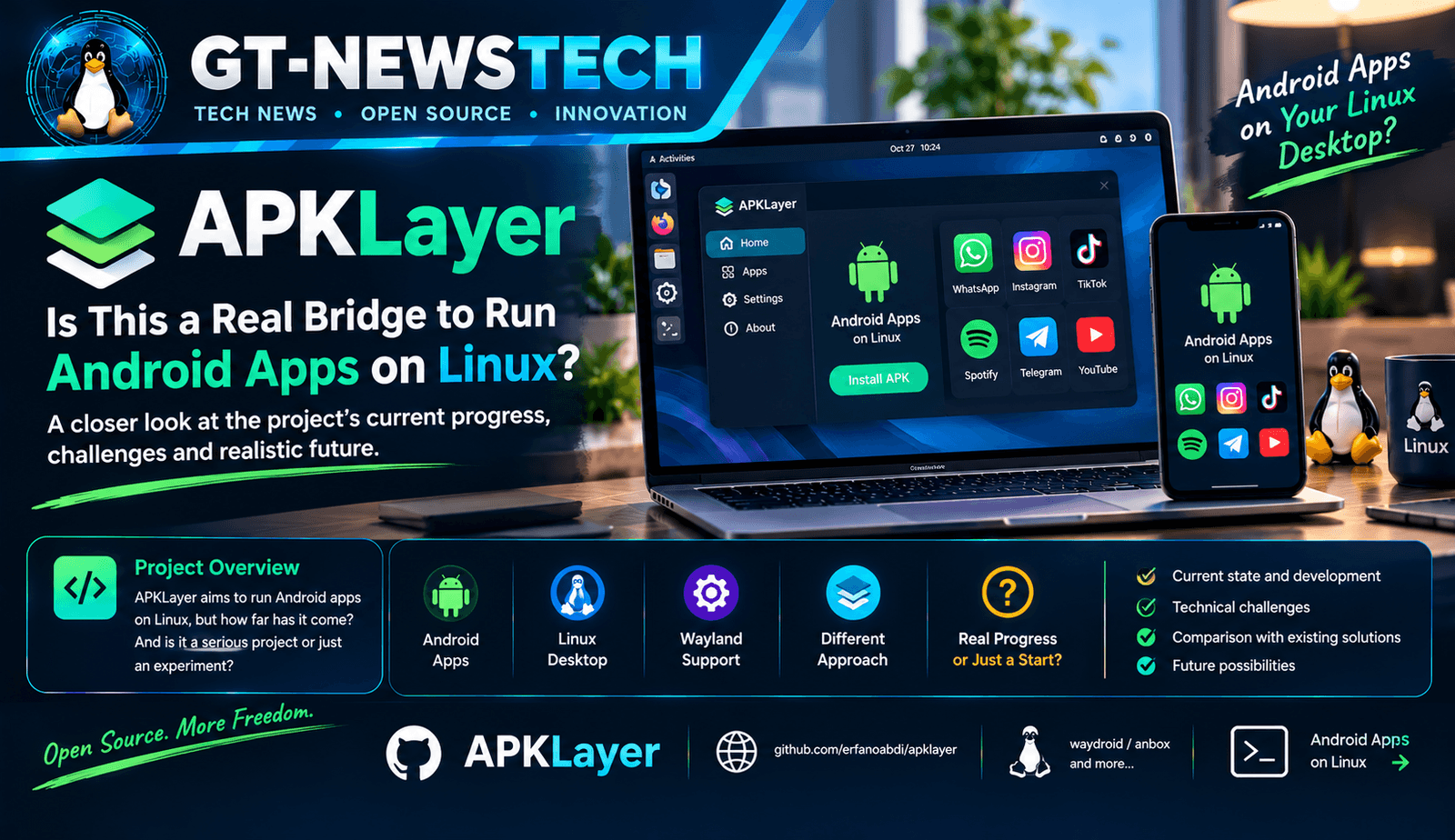
What Is APKLayer?
In the world of running Android apps on Linux, there are established solutions like Waydroid (which relies on LXC containers) and Anbox (also container-based). From time to time, new projects appear attempting a different approach.
APKLayer is a project by developer erfanoabdi, a developer known in the Android community for projects related to analyzing and modifying APK files (such as APK Editor Studio). The project’s name suggests an attempt to create a “layer” to run Android apps, possibly through different technologies than traditional containers.
🔗 Official Repository: github.com/erfanoabdi/apklayer
Progress and Seriousness
Based on the nature of projects in this category, APKLayer can be assessed from several angles:
Technical Maturity
Projects bearing the name “Layer” are usually in their early stages. If the project relies on technologies like Wayland, virtualization, or translation libraries (similar to the Android Translation Layer approach [citation:3]), development takes a long time. Similar projects like Waydroid started years ago and still face performance and compatibility challenges.
Developer Activity
erfanoabdi is an active developer in the Android community, but his primary focus has been on APK tools [citation:2]. If APKLayer is a side project, it may not receive the same development pace as a project like Waydroid backed by a large community.
Technical and Practical Challenges
Running Android apps on Linux is no easy task. The main challenges include:
| Challenge | Details |
|---|---|
| Architecture Support | Android apps run on ARM, while most Linux computers run on x86_64. Translation consumes significant performance |
| Google Play Support | Most apps rely on Google Play services, and running them requires licenses and a complex environment |
| Performance | Running an Android app on Linux through multiple layers (Container + Translation) may be slower than native execution |
| Desktop Integration | Android apps do not follow Linux desktop conventions (notifications, clipboard, drag and drop) |
Comparison with Existing Solutions
| Solution | Technology | Status | Support |
|---|---|---|---|
| Waydroid | LXC containers + LineageOS | Relatively stable | Large community |
| Anbox | LXC containers | Discontinued/old | Limited |
| APKLayer | Not precisely defined | Early | Individual |
Could It Work in the Future?
The answer depends on three factors:
- Transparency and Documentation: If the project accurately documents how it works and its requirements, the community can contribute.
- Focus on a Specific Problem: Instead of trying to “run everything,” if APKLayer focuses on a specific category of apps (like games or simple tools), it might succeed.
- Leveraging Existing Infrastructure: If the project reuses components from Waydroid or Anbox instead of building everything from scratch, it will be more realistic.
Summary
APKLayer is an interesting project, but it is in a very early stage. It cannot be judged as a ready alternative to Waydroid at this time. Its seriousness depends on the developer’s continuity and ability to attract contributors. If you are looking for a practical solution to run Android apps on Linux today, Waydroid is the most realistic option. As for APKLayer, it is worth following, but with realistic expectations.
Quick Links
Waydroid — The Most Mature Solution for Running Android on Linux
APK Editor Studio — Another Project by the Same Developer
Published in the Free and Open Source Software section – Applications and Systems


Reactions & Comments
Sign in with GitHub to leave a comment or react. Powered by Giscus (stored in GitHub Discussions)