
This article will be published soon
Scheduled for: 2026-05-27 15:19
The article will appear automatically when the time arrives — no need to refresh.
The Problem of Domain Name Costs
For anyone wanting to create a website, the first obstacle is the domain name. Prices start at $8 to $15 per year for regular domains like .com, .org, and .net, and rise to tens or hundreds of dollars for premium domains. This amount might be small in some countries, but it is significant in others, especially for students, very small project owners, or those who just want to try creating a website without financial commitment.
FreeDomain came to solve this problem in a simple and direct way. Free domains, completely free, with no strings attached, no hidden fees, and no ads.
🔗 Official Repository: github.com/DigitalPlatDev/FreeDomain
What Is FreeDomain?
FreeDomain is an open source project from the DigitalPlat Foundation, founded by developer Edward Hsing when he was 15 years old as a small DNS experiment for his friends. Over time, the project grew to become a platform used by over 500,000 people worldwide.
The idea is simple. The project offers domain names under free extensions such as .dpdns.org, .us.kg, .qzz.io, .xx.kg, and .qd.je. Anyone can register and get their own domain, then use any DNS provider they want, such as Cloudflare, FreeDNS, or Hostry, to point the domain to their own server.
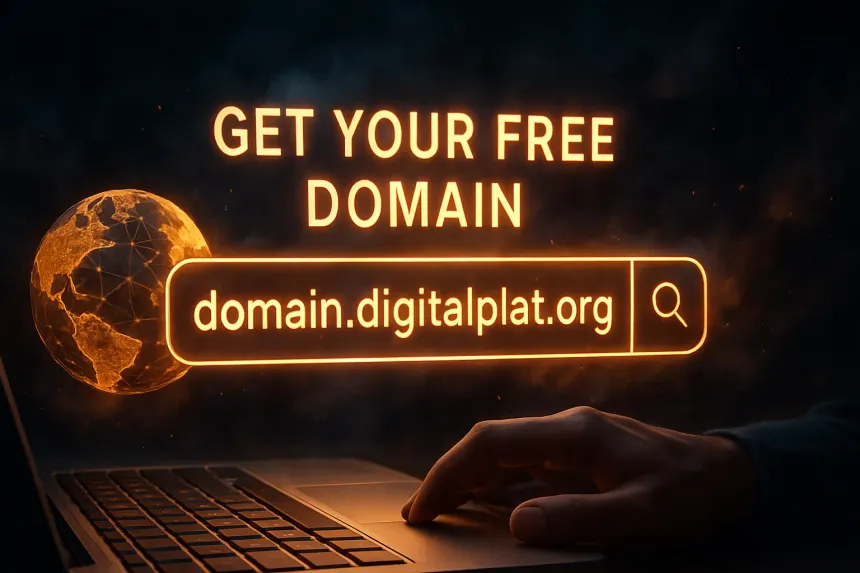
🔗 Official Website: domain.digitalplat.org
Currently Available Extensions
.DPDNS.ORG is the primary and most used extension, managed directly by the project.
.US.KG is available through a partnership with a provider from Kyrgyzstan, suitable for personal websites and small projects.
.QZZ.IO is short and easy to remember, suitable for technical projects.
.XX.KG is another alternative within the .kg top-level domain.
.QD.JE is from Jersey, suitable for projects wanting a European appearance.
The team has indicated that additional extensions will be added in the future, depending on demand and availability.
Why Free Domains?
According to the developer, the primary goal is to make the web more accessible to everyone. The cost of a domain should not be a barrier for anyone wanting to create a website. The project is completely independent, designed and maintained by Edward Hsing, without any ties to commercial companies that impose conditions or ads.
FreeDomain is not a permanent replacement for paid domains, but it is an excellent option for personal projects, small blogs, portfolio sites, student projects, or anything that does not require a high level of commercial trust.
How It Works
The registration process is simple and takes only a few minutes.
First, you visit the dashboard at domain.digitalplat.org. Second, you search for the name you want within the available extensions. Third, if the name is not already taken, you register it for free. Fourth, you get the domain and can start using it immediately.
After registration, you can use any DNS provider. The project does not force you to use specific DNS servers. You can add the domain to Cloudflare, FreeDNS, Hostry, or even run your own DNS server. This means you have full control over how the domain is pointed.
The dashboard also provides options to manage registered domains, renew them (renewal is also free as long as the domain remains within fair use policy), and delete them if you no longer need them.
Security and Privacy
The project takes security seriously. There is a dedicated email address for abuse reporting: abusereport@digitalplat.org. The team reviews each report carefully, and processing time can range from a few hours to several days depending on the complexity of the case.
Important security notice. The previous Telegram account and group were compromised and are no longer under the team’s control. The project no longer uses Telegram as an official communication channel. Do not trust any messages, links, or announcements coming from Telegram, especially those related to bonuses, earnings, or external sites.
The official channel is now Discord, where you can get support, follow updates, and connect with the community.
Statistics and Trust
According to the project page, over 500,000 domains have been registered so far. This is a large number for any service, whether free or paid. The trust the project has earned from this many users indicates that it is not just a passing experiment, but a stable platform that can be relied upon.
The project is completely open source, with code available on GitHub. Anyone can review the code, suggest improvements, or even run their own version of the service.
Current Limitations
First, the domains are free, but they are not full ownership. They are leased as long as you abide by the fair use policy. If you stop using the domain for a long period or violate the terms, the domain may be returned to the public pool.
Second, some extensions may be less well-known than .com or .org. This may affect visitor trust or search engine optimization, but for personal and small projects, this is not a major obstacle.
Third, customer support relies on the Discord community and one primary developer, Edward Hsing. There is no guarantee of a fixed response time. If you are running a critical commercial site, FreeDomain may not be the right choice.
Comparison with Free Alternatives
Freenom was the most well-known provider of free domains such as .tk, .ml, .ga, .cf, and .gq. But the service deteriorated in recent years, becoming unreliable, with many domains revoked without warning. FreeDomain operates on a different model and relies on an open source community, making it more transparent and stable.
Dot.tk, now part of Freenom, offered free domains with mandatory ads. FreeDomain does not force any ads.
InfinityFree and 000Webhost offer free hosting with subdomains, but not independent domains. FreeDomain gives you an independent domain that can be used with any hosting, even with free services like GitHub Pages, Vercel, or Netlify.
What the Developer Says
In an article published on Dev.to titled “I bought a domain at 15, now it powers 400,000 users”, Edward Hsing explains how the project started as a small experiment when he was fifteen, and how it grew unexpectedly to serve hundreds of thousands of users.
He writes: “This started as a small DNS experiment, letting a few friends use subdomains. Over time, it grew into something people actually rely on, and running it turned out to be much harder than building it.” This explains why the project remains alive and stable after all these years.
Summary
FreeDomain is not a commercial project seeking profit. It is a community-driven open source project, with the primary goal of removing the financial barrier to entering the web. If you are a student wanting to create a site for a graduation project, a developer wanting to showcase your portfolio, a beginner blogger who does not want to pay $15 before knowing whether people will read your articles, or anyone wanting to try building a website without financial commitment, FreeDomain is an excellent choice.
You do not have to stay on the free domain forever. You can start with it, build your audience, and in the future when your site grows, you can purchase a paid domain such as .com and move everything to it. By then, the free domain will have served its purpose: getting you started.
Quick Links
https://github.com/DigitalPlatDev/FreeDomain
https://domain.digitalplat.org
https://dev.to/edwardhsing/i-bought-a-domain-at-15-now-it-powers-400000-users-7ol


Reactions & Comments
Sign in with GitHub to leave a comment or react. Powered by Giscus (stored in GitHub Discussions)